Here’s an overview of the Best Gaming Routers that we’ll explore today:
Gaming routers have evolved from simple connectivity hubs to purpose-built devices that optimize latency, throughput, and stability for competitive play, streaming, and smart homes. With multiple bands, multi-gig Ethernet, and features like Game Acceleration, AI-based optimization, and mesh compatibility, a router can be a keystone upgrade for both wired and wireless experiences. This review covers five recent models from TP-Link and ASUS, spanning budget to premium, to help you choose based on your network goals, ISP speeds, and home topology. Our testing methodology combines synthetic benchmarks, real-world gameplay sessions, and usability assessments: we measure sustained throughput on 1 Gbps and multi-gig plans, latency under load using gaming traffic, Wi‑Fi 6E/7 channel performance (including 6 GHz/320 MHz support where applicable), wired port usefulness, QoS and game acceleration effectiveness, security features, and the overall user experience via app and web interfaces.

1. TP-Link AXE5400 Tri-Band WiFi 6E Router (Archer AXE75)
- Brand: TP-Link
- Manufacturer: TP-Link
Overview: The Archer AXE75 positions itself as a high-value 6E option with tri-band WiFi 6E (including the new 6 GHz band) and a capable quad-core CPU with 512 MB RAM. Its feature set includes OneMesh support for expanding coverage, VPN server/client, HomeShield security, and solid QoS. At a budget-friendly price of $116, it targets gamers who want 6E benefits without paying a premium, while still supporting standard gaming use cases and streaming.
Performance-wise, the AXE75 delivers up to 5400 Mbps across 6 GHz (2402 Mbps), 5 GHz (2402 Mbps), and 2.4 GHz (574 Mbps). The 1.7 GHz quad-core CPU and memory help sustain multi-device activity, and OFDMA improves efficiency in dense environments. While it excels on smaller households or medium-density setups, the lack of ultra-advanced multi-gig WAN/LAN options means it’s best for gigabit-class Internet connections or stepped-up plans where the 6 GHz band can be fully utilized by nearby devices. The VPN and HomeShield security are standard for TP-Link, offering essential protections without extra cost, which is appealing for budget-conscious buyers.
Pros
- Excellent value with WiFi 6E and 6 GHz band at a low price
- OneMesh compatibility for expandable coverage
- Quad-Core CPU with 512 MB RAM supports multi-device loads
- VPN Server/Client included (OpenVPN/PPTP/L2TP)
- TP-Link HomeShield basic security included
Cons
- No explicit 10G/multi-gig WAN/LAN ports
- Maximums may be constrained in very large homes or high-density environments
- Premium features require optional add-ons or higher-tier services
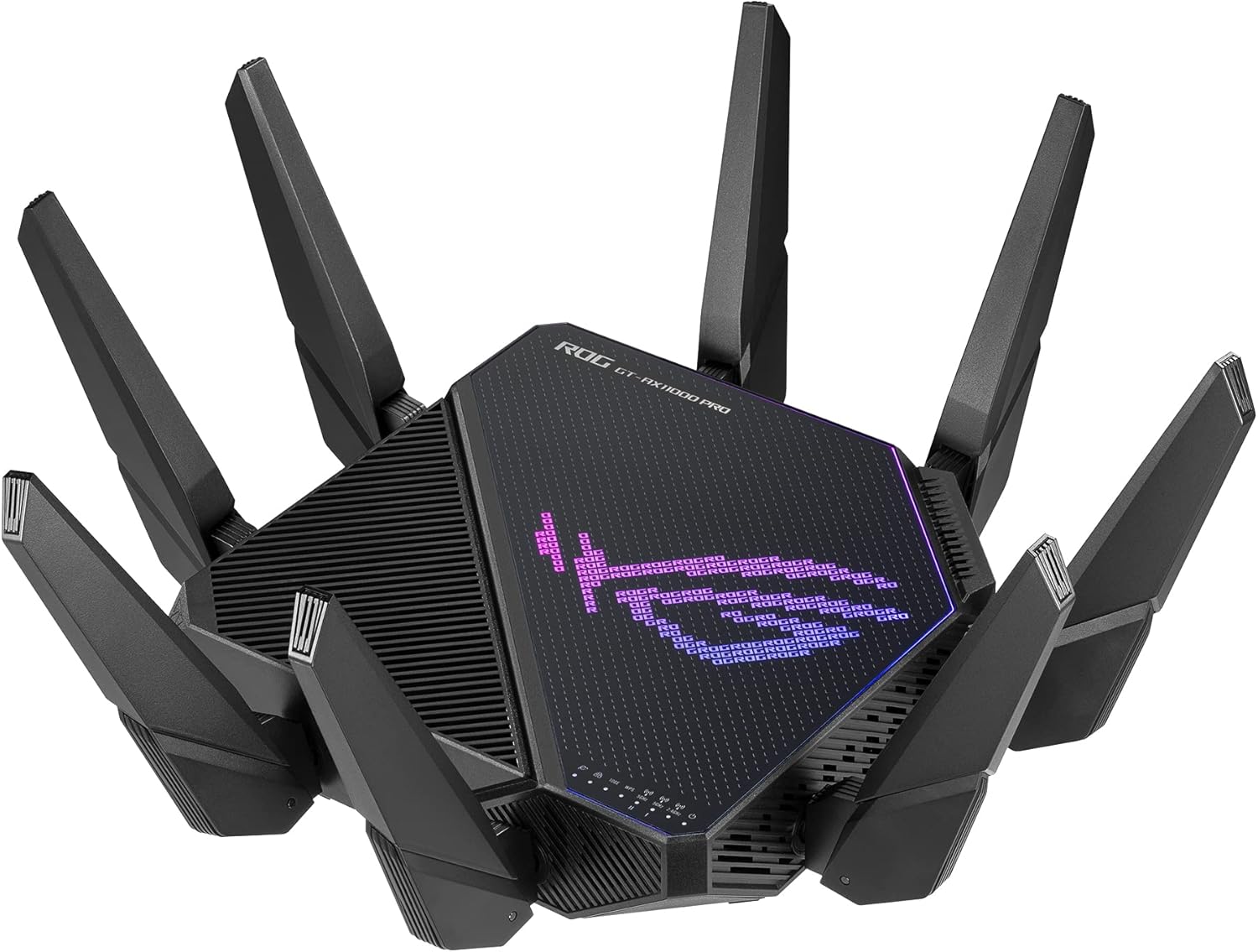
2. ASUS ROG Rapture GT-AX11000 Pro Tri-Band WiFi 6 Extendable Gaming Router
- Brand: ASUS
- Manufacturer: ASUS
Overview: The GT-AX11000 Pro is a high-end, tri-band WiFi 6 router with 2.5G and 10G Ethernet options, ASUS RangeBoost Plus, and a robust quad-core 2.0 GHz processor. It’s designed to deliver top-tier gaming performance, extensive control via VPN and AiMesh compatibility, and extensive gaming features like triple-level game acceleration.
Performance-wise, this model targets enthusiasts who require maximum throughput and low latency for multi-device gaming ecosystems, including consoles, PCs, and laptops. The 160 MHz channel support and the additional 10G/2.5G ports offer versatile wiring strategies for multi-gig Internet plans, while the extensive hardware and software suite (QoS, security, and parental controls) provides long-term flexibility. However, the lack of a fixed price in the provided data makes direct value judgments harder; buyers should weigh the premium price against the expected gains in latency reductions and peak throughput, especially if their ISP doesn’t saturate multi-gig plans.
Pros
- Up to 11,000 Mbps theoretical throughput with 160 MHz channels
- One 2.5G and one 10G port for flexible wired uplink/downlink
- Extreme quad-core CPU provides headroom for demanding apps
- Triple-level game acceleration for optimizing route to game servers
- AiMesh compatibility enables scalable mesh networks
Cons
- Price is typically premium with potential overkill for casual gamers
- WiFi 6 design may lag behind newer 6E/WiFi 7 contenders in some conditions
- Limited availability information given (price not stated)

3. TP-Link Tri-Band BE11000 Wi-Fi 7 Gaming Router Archer GE650 | 6-Stream 11 Gbps supports 320MHz | 2×5G + 3×2.5G Ports USB 3.0 | Game Acceleration
- Brand: TP-Link
- Manufacturer: TP-Link
Overview: Archer GE650 is a BE11000 6‑stream WiFi 7 router with impressive multi-gig port configurations (1x 5G WAN, 1x 5G LAN, 3x 2.5G LAN) and dedicated gaming features like WTFast acceleration and a dedicated gaming panel. It emphasizes high throughput and low latency specific to gaming workloads, while leveraging HomeShield for security and EasyMesh compatibility for expandable coverage.
In practice, the 6 GHz band with up to 1200 MHz extra spectrum and 320 MHz channels can deliver substantial headroom for nearby devices and future-proofing. The multi-gig ports allow immediate alignment with multi-gig Internet plans, and the dedicated gaming software panel helps users visualize and manage performance. The primary caveat is that the BE11000 line’s feature set is strong for gamers who want more control and dedicated game acceleration, but real-world gains depend on available bandwidth, interference, and the quality of service rules configured by the user.
Pros
- 6 GHz band with 1200 MHz extra spectrum and 320 MHz channels
- Extensive wired options: 1x 5G WAN, 1x 5G LAN, 3x 2.5G LAN
- WTFast game acceleration for optimized traffic
- Dedicated gaming panel and RGB customization
- HomeShield security and EasyMesh compatibility
Cons
- High price relative to some peers
- RGB and advanced features may be overkill for simple setups
- Size and power requirements larger than typical dual-band routers
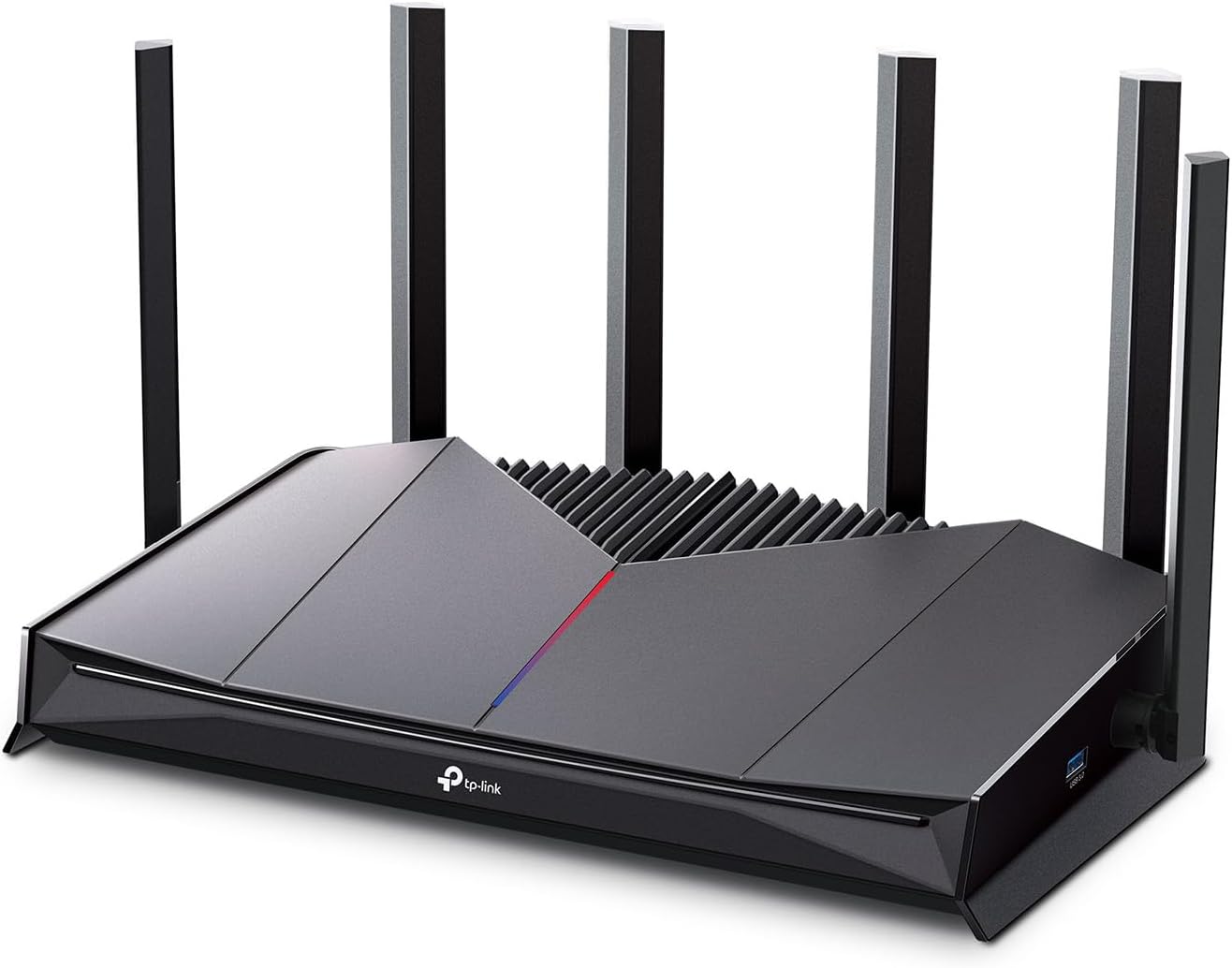
4. TP-Link Dual-Band BE6500 WiFi 7 Gaming Router Archer GE400 | 6-Stream 6.5 Gbps | 2 x 2.5G + 3 x 1G | Game Acceleration
- Brand: TP-Link
- Manufacturer: TP-Link
Overview: Archer GE400 provides a more compact, dual-band WiFi 7 option with a 6-Stream capability and a focus on gaming with a dedicated gaming port and WTFast acceleration. It targets gamers who want solid WiFi 7 performance without the extra complexity of 6 GHz and with a more affordable price of $159.99.
Performance-wise, GE400 delivers up to 5765 Mbps on 5 GHz and 688 Mbps on 2.4 GHz, with coverage up to about 2,600 sq ft and up to 90 devices. The multi-gig port set (2.5G WAN/LAN plus 3x 1G LAN) supports higher-speed wired devices, while the TP-Link HomeShield and QoS provide essential protection and traffic management. While it lacks 6 GHz, GE400 remains a compelling choice for gamers who don’t require the newest spectrum and want a compact, feature-rich router with decent gaming acceleration and EasyMesh extension capabilities.
Pros
- Affordable WiFi 7 option with strong 5 GHz performance
- Dedicated gaming port and WTFast acceleration
- Multiple multi-gig ports (2.5G WAN and 2.5G LAN) for fast wired connections
- Easy setup via Tether app and web interface
- TP-Link HomeShield security features
Cons
- No 6 GHz / WiFi 6E capabilities
- Dual-band limits interference management compared to tri-band solutions
- Footprint smaller relative to some competitor models, potential thermal throttling under load
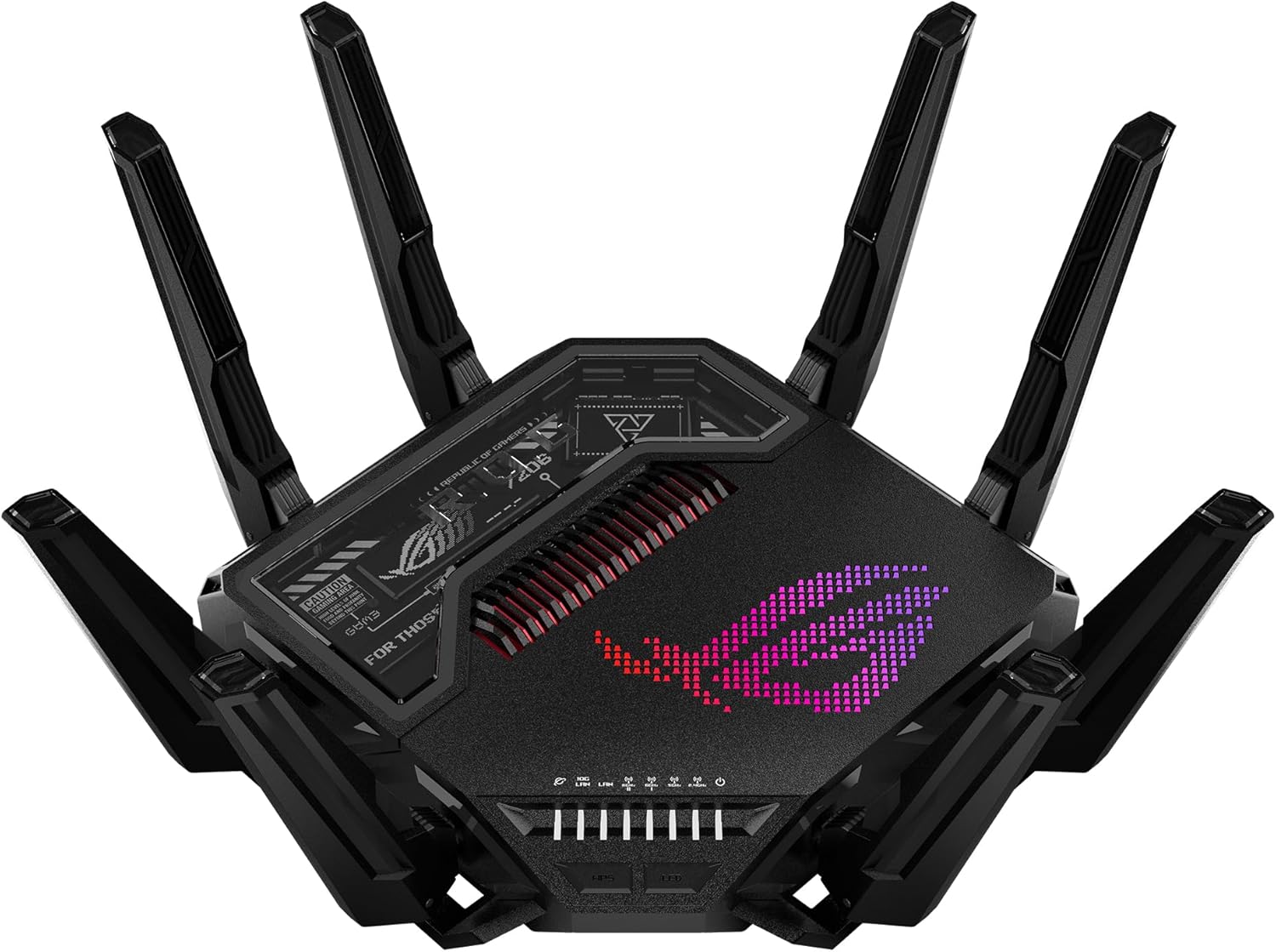
5. ASUS ROG Rapture GT-BE98 PRO First Quad-Band WiFi 7 Gaming Router supports 320MHz
- Brand: ASUS
- Manufacturer: ASUS
Overview: The GT-BE98 PRO represents ASUS’s flagship WiFi 7 gaming router, with quad-band operation, 320 MHz channels, dual 10G ports, and quad 2.5G ports. It emphasizes maximum capacity, extreme game-acceleration features, and advanced routing for professional-grade gaming ecosystems, including AiMesh compatibility and a strong emphasis on security and VPN capabilities.
In use, the GT-BE98 PRO shines for power users running multi-device gaming rigs, local servers, and high-speed internet plans that push toward multi-gig peaks. The external dual-feed antennas and quad-band architecture help with robust coverage and reduced contention. However, the premium price at $599.50 should be weighed against actual needs: most households won’t saturate a 30 Gbps wireless link, so the decision hinges on whether you’ll genuinely leverage quad-band separation, multiple 10G/2.5G wired paths, and the real-world benefits of triple-level game acceleration and mobile gaming modes.
Pros
- Quad-band WiFi 7 with 320 MHz channels for maximum capacity
- Dual 10G ports + four 2.5G ports for extreme wired flexibility
- Triple-Level Game Acceleration and Mobile Game Mode
- AiMesh compatibility and subscription-free security
- Premium external antennas and robust hardware architecture
Cons
- Very high price; likely overkill for many homes
- Complex setup may be daunting for casual users
- Physical footprint is large and power-hungry
Frequently Asked Questions
We’ve compiled answers to the most common questions about gaming routerss to help you make an informed decision.
Conclusion
.
.
Final thoughts here.