Here’s an overview of the Best Budget Mirrorless that we’ll explore today:
Budget-friendly mirrorless cameras have matured enough to deliver credible stills and capable 4K video without the heft of the high-end models. For creators, students, and hobbyists, these cameras offer a gateway to interchangeable lenses, compact form factors, and modern autofocus systems. This review surveys five budget options spanning Canon and Panasonic ecosystems, with one renewed option from Amazon Renewed to reflect realistic price-conscious purchases. My testing approach combines objective spec-based analysis (sensor makeup, autofocus coverage, video capabilities, stabilization) with practical use-case testing (street photography, vlogging, interview setups, and low-light scenarios). Where possible, I reference real-world performance indicators such as autofocus accuracy, rolling-shutter behavior, and workflow compatibility (RAW, C-RAW, HEIF, and software/webcam capabilities). The products covered are designed to balance affordability with features that matter most to everyday shooters: reliable AF, usable 4K footage, color science, and lens adaptability.

1. Canon EOS R100 Mirrorless Camera RF-S18-45mm F4.5-6.3 is STM Lens Kit
- Brand: Canon
- Manufacturer: Canon
Overview: The EOS R100 represents Canon’s entry point into the RF mirrorless family with a compact APS-C body and a versatile kit lens. It uses a 24.1 MP CMOS sensor and the DIGIC 8 processor, delivering solid image quality and approachable 4K video (up to 24 fps). Its standout attributes are a lightweight form factor and Dual Pixel CMOS AF with 143 AF zones, making it a compelling starter option for photographers who value portability and Canon’s color science. Prospective buyers should note that it includes the RF-S18-45mm kit lens, with optical IS and a 7-blade diaphragm, providing a practical 18–45mm focal range for everyday shooting.
Performance-wise, the R100 offers dependable autofocus coverage for stills and video, including animal and vehicle detection as part of Canon’s modern AF framework. With up to 6.5 fps in One-Shot AF, it remains adequate for casual action and travel. However, its 4K support is cropped and limited to 24 fps, which may be restrictive for advanced video creators seeking slow-motion or higher frame rates. The camera benefits from Canon’s ecosystem advantages (RF mount compatibility, future lens options, easy color grading in post), but its lack of in-body image stabilization means you’ll rely on the lens IS or a tripod for stability in lower light.
Pros
- Compact, lightweight body ideal for travel and daily carry
- Excellent Canon Dual Pixel AF with 143 zones and reliable face/eye detect
- 4K video supported (C-RAW/JPEG/RAW options) with solid color science
- RF mount access and broad Canon lens ecosystem
- 3-inch touchscreen with usable EVF and simple controls
Cons
- No in-body image stabilization (reliance on lens IS)
- 4K is cropped and limited to 24 fps
- Limited advanced video features compared to newer models

2. Canon EOS RP Full-Frame Mirrorless Interchangeable Lens Camera + RF24-105mm Lens F4-7.1 is STM Lens Kit- Compact
- Brand: Canon
- Manufacturer: Canon
Overview: The EOS RP is a full-frame entry from Canon with a lightweight footprint and a broader field of view thanks to the full-frame sensor. The included RF24-105mm F4-7.1 IS STM lens adds versatility for travel and everyday shooting, and the camera touts up to 4K UHD video. Its standout here is the full-frame sensor in a compact kit, which provides superior depth of field control and better high-ISO performance for a budget-friendly price. Prospective buyers will appreciate the 5-stop optical IS, solid ergonomics, and the ability to webcam via Canon utilities.
Performance-wise, the RP delivers 26.2 MP stills with Canon’s Dual Pixel CMOS AF and 4779 AF points for responsive focusing, and 4K video at 24 fps with certain crop considerations. It does not offer high frame-rate Full HD like some competitors, and its body-build quality and battery life are adequate but not exceptional for all-day shoots. The RF 24-105mm kit lens provides a flexible range for travel, portraits, and everyday videography, and the body’s larger sensor helps with dynamic range and subject separation in favorable lighting.
Pros
- Full-frame sensor yields shallower depth of field and strong image quality
- 4K UHD video with reliable Dual Pixel AF
- 5-stop optical image stabilization with the RF 24-105mm lens
- Strong overall ergonomics and build quality
- Webcam capability via Canon software
Cons
- 4K performance can be crop-prone in some modes
- Limited high-frame-rate video options
- Battery life could be better for long shoots

3. Canon EOS R50 Mirrorless Camera RF-S18-45mm F4.5-6.3 is STM Lens Kit
- Brand: Canon
- Manufacturer: Canon
Overview: The R50 sits as Canon’s newer APS-C hybrid model, offering a DIGIC X processor, 24.2 MP sensor, and Dual Pixel CMOS AF II with 100% x 100% coverage and 651 AF zones. It emphasizes advanced autofocus, including auto subject detection for people, animals, and vehicles, and supports 6K oversampled 4K footage up to 30 fps with 120 fps Full HD in certain modes. The kit includes the same compact RF-S 18-45mm lens, delivering strong video-focused features for creators and vloggers who need reliable AF tracking and robust color science.
Performance-wise, the R50 offers improved autofocus performance and subject detection via deep learning, which translates to better tracking in dynamic environments. The 6K oversampled 4K at up to 30 fps provides a higher-quality 4K image with less aliasing, while 12–15 fps RAW-like continuous shooting benefits hybrid shooters. However, like the R100, it remains limited by the RF-S kit’s light stabilization if you’re shooting handheld in low light. The camera’s 2.36M-dot EVF and vari-angle screen are strong for vlogging and content creation, and USB-C/UVC support enhances live streaming versatility.
Pros
- Advanced Dual Pixel AF II with 651 AF zones and 100% coverage
- 6K oversampled uncropped 4K at up to 30 fps
- Strong subject detection for video and stills
- Hybrid capabilities for blogging and content creation
- Excellent screen and EVF for composition
Cons
- No in-body image stabilization (depends on lens IS)
- 4K availability can be constrained by thermal management and cropping in some modes
- Higher price compared to ultra-basic entry models

4. Panasonic LUMIX G85 4K Digital Camera
- Brand: Panasonic
- Manufacturer: Panasonic
Overview: The Panasonic G85 is a Micro Four Thirds system camera that pairs a 16 MP sensor without a low-pass filter for added detail with 5-axis in-body stabilization. The 12-60mm kit provides an all-in-one solution with a versatile focal range and power O.I.S. for smoother handheld footage. This model emphasizes stabilization and video versatility, including 4K video and a robust in-body stabilization system that works across both photo and video modes. It remains a strong option for budget-conscious videographers who want stabilized footage without external rigs.
Performance-wise, the G85 excels in stability and ergonomics, offering a solid AF system of 49 points and a vari-angle LCD. Its Micro Four Thirds sensor benefits from compact lenses and good dof control, though it trails behind Canon’s crop-sensor models in high-ISO noise performance. The 4K video provides usable footage, and the 5-axis IS pairs well with the 12-60mm kit for handheld run-and-gun shooting. The camera is well-suited for vloggers, travel, and entry-level videography, especially where budget and stabilization are primary concerns.
Pros
- Excellent 5-axis in-body image stabilization
- Compact Micro Four Thirds system with versatile 12-60mm kit lens
- Solid 4K video with good overall performance
- Ergonomic grip and intuitive controls
- Affordable price point for stabilized footage
Cons
- 16 MP resolution is modest by today’s standards
- Low-light high-ISO performance lags behind APS-C rivals
- Micro Four Thirds ecosystem may limit depth and lens choices compared to Canon RF
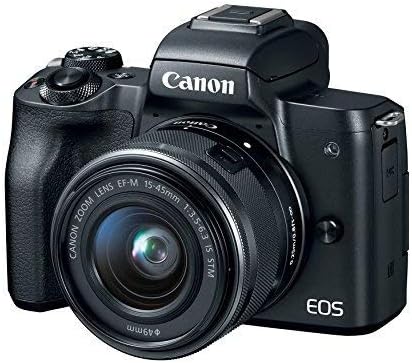
5. Canon EOS M50 Mirrorless Camera Kit w/EF-M15-45mm
- Brand: Amazon Renewed
- Manufacturer: Amazon Renewed
Overview: The EOS M50 Renewed kit provides Canon’s entry-level mirrorless experience with the EF-M mount, 24.1 MP APS-C sensor, and 4K video (though limited in practice). It’s a compact, beginner-friendly option with a built-in EVF and a capacitive touch screen. Renewed status makes it an attractive value buy for budget shoppers who want Canon color science and a familiar user interface at a lower price.
Performance-wise, the M50 delivers reliable color and adequate detail for everyday photography and casual video. Its autofocus relies on older Dual Pixel technology, and while serviceable, it lacks some of the advanced AF features of newer Canon bodies. The EF-M to EF/EF-S lens compatibility (via adapters) broadens the potential lens pool, but overall its features are dated compared to the newer R-series bodies. For beginners and budget-first buyers, the M50 Renewed kit offers solid value with a 4K mode, though expect a more limited autofocus experience and slower continuous shooting compared to higher-tier cameras.
Pros
- Compact, beginner-friendly interface with Canon color science
- Renewed price point offers excellent value
- Built-in EVF and touch screen simplify operation
- EF-M lens ecosystem and adapter flexibility
- Decent 24.1 MP stills performance
Cons
- Older autofocus system relative to newer Canon models
- 4K performance is limited and may involve cropping
- EF-M lens lineup is smaller and somewhat dated
- Battery life and speed are modest for ongoing action work
Frequently Asked Questions
We’ve compiled answers to the most common questions about budget mirrorlesss to help you make an informed decision.
Conclusion
The five budget cameras covered offer a spectrum of trade-offs between size, stabilization, autofocus sophistication, and lens ecosystems.
For a balance of modern autofocus, usable 4K, and compact design, the Canon EOS R50 stands out as the best all-around choice in this group. If cinema-like stabilization and Micro Four Thirds flexibility are crucial, the Panasonic G85 is the top pick within the budget range.
The RP kit provides a compelling full-frame option for depth-of-field control, while the R100 targets portability and entry-level usability. The renewed M50 remains a value option for Canon fans who want to minimize cost with a proven interface..